Saturday, August 4, 2012

Montserrat

So, where the hell was Alex (see below, for Alex's "where the hell is Matt" dance)? He was at Montserrat, a monastery poised upon a cliff about an hour northwest of Barcelona. Pilgrims have flocked to this spot for 1,000 years, although the monastery there today is of more recent vintage. The draw for pilgrims (aside from the amazing view, which you would definitely want as payoff for the climb!) is the black Madonna, known as La Moreneta, or the dark lady, a wooden sculpture of Mary and baby Jesus, whose face and hands turned black, probably from the lead paint originally used, and then painted black on purpose.

There is still a long line today to see her, and we are the Waits; we don't like to wait. So I captured a photo from afar:


Although the statue itself is made of wood, the monastery now has the funds to display her in the most ornate setting, on a silver throne. She holds an orb in her right hand, apparently representing the universe, and pilgrims touch it and beseech her for a miracle (here's someone else's close-up, swiped from the Internet -->).

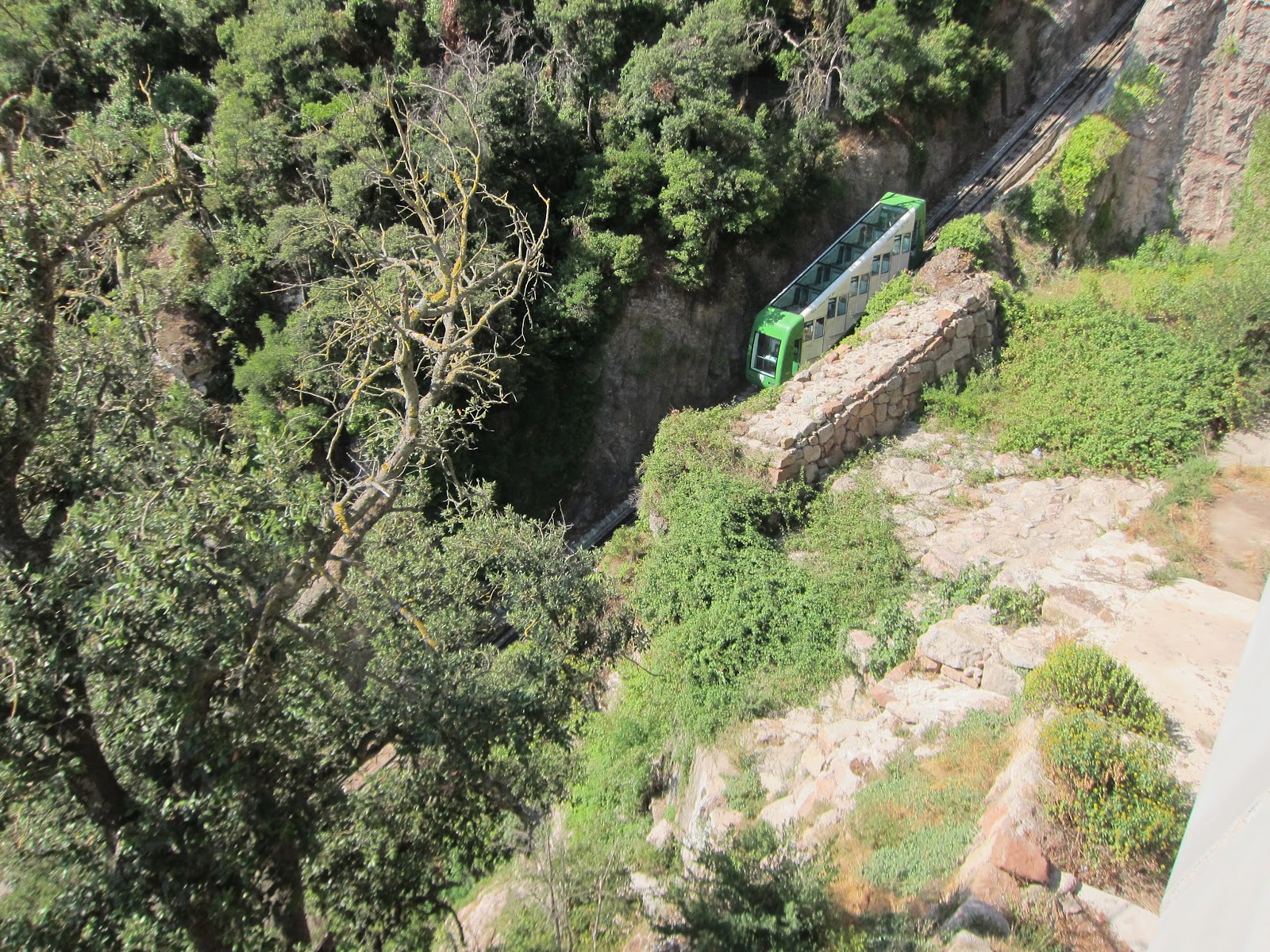
And that would be great for some people---but that's not the only reason to come to Montserrat. The monastery itself is about 2500 feet above the plain below, and luckily tourists today can take the cable car up. And to climb among the cliffs, there are also short funiculars to get you even higher. Here are the shots of our amazing day at Montserrat.

Cable car ride up.


Then we took the funicular up higher...

...and looked back down at the monastery below.
One of the goals of our hike: a small chapel. To the right, you can see the remnants of old monastery buildings, largely gone now but for some stone walls.


Alex, Arthur, and Eloise continued on up higher. Anna and I stayed below and ate potato chips.
(After all, she had carried that bag of potato chips the whole way, and it looked about to burst from the elevation change. It would have been a shame to waste them!)

All of us on the hike (plus the potato chips).
Alex higher up.


The amazing rock formations (and a cross out at the edge).
Montserrat has it all: amazing landscape, terrifying cable car ride, beautiful church, gorgeous hike, and even an impressive museum. We spent nearly the whole day (until about the time I discovered that I had lost my debit card somewhere between buying the train tickets and turning in my audio guide. But I canceled it once we were back at home, and there was no unauthorized activity. My lucky-unlucky streak continues!).

Anna took a 5-minute video of the whole ride down in the cable car. If I ever get a better Internet connection, I might upload it. Suffice it to say, we were really &%$#! high!

Where the Hell Is Alex?

Alex does the "Where the Hell Is Matt" dance:


Thursday, August 2, 2012

Hiking in the Pyranees

Our first guided tour of the trip: a hike in the Pyranees, to see cliffs, waterfalls, and medieval villages. Gramma had found this wonderful "small group" tour company, and the group consisted only of the five of us, a couple from Australia, and our Russian-Israeli-Spanish Guide, Alex (born in Moldavia when it was a Soviet Republic, moved to Israel when he was 6 and still an Israeli citizen, but has lived in Spain for 6 years; he speaks about six different languages!). 

We have been wilting in the heat and humidity of Barcelona, and we had hoped for relief in the mountains. It was still hot, but the humidity was much reduced, so we were very happy about that!

Here are a few of the better photos (wish Arthur had brought his really good camera):

The trekkers, with the village of Rupit i Pruit in the background.

Houses along the cobblestone streets. Many had stones over the door with the year of construction carved in. The oldest we saw were from about the 1610s and 1620s. But some are also new, built to fit in with the older stone buildings.


Out on the hike: Alex, our guide, and Arthur talking politics and the global economy.


Most of us posing on a rock overhang.
 
There's Anna. Now she's willing to pose for the camera.

Alex and Alex looking down the sheer cliff face, both turned when I called: Alex!


Anna had control of the camera. I promised to post this picture of a bee.

Looking over the waterfall, except it doesn't flow this time of year.


About to cross the rope bridge that connects two sides of the village, with a creek running down the middle.

Imagine Alex doing the voice of Donkey from Shrek across the whole thing.


Wednesday, August 1, 2012

La Sagrada Familia

This beautiful, incredible cathedral-in-progress (since 1882) probably speaks for itself, and has been professionally photographed by many others, so I'll only share a few of my amateur shots.

I was here in 1989, so on this visit I was baffled why almost none of it looked familiar. The only part I remembered was the "Nativity Facade," the side that Gaudi himself worked on before his death. I had no memory of the amazing, stunning, tree-like columns of the interior. Photos and timelines at the cathedral museum confirmed that much work has been done since 1989, but this photo I found from 1988 shows that the interior essentially did not exist back then: http://en.wikipedia.org/wiki/File:Sagrada_Familia_Construction_1988.jpg. That's why I didn't remember it! This one from 1993 shows the tree-like columns being erected: http://www.gaudiallgaudi.com/images/1993d.JPG. They are so incredible. Absolutely mind-blowing.

Here is what I was able to capture of this incredible place:


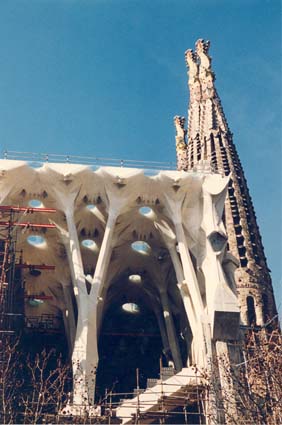
I have to begin with the tree-like columns, because they are absolutely amazing. They are a Gaudi creation, but he never lived to see them realized. He knew the cathedral would take decades more to complete, so he left detailed plans for his vision. What a vision.


Looking straight up to the ceiling of the cathedral.
Today, the team funding and leading the continued construction are creating and installing stained glass, slowly, slowly, around the entire cathedral.

Here you can see the completed windows next to the ones that are not yet completed.
This is the "Nativity Facade," that was completed back in the 1930s and on which Gaudi himself worked most directly, before his death in 1926.


The Nativity Facade depicts Jesus's birth, whereas the "Passion Facade," which is newly complete, depicts his death. Hence, on this side the wise men, but also many symbols of life, abundance, growth...

...and on the Passion Facade side, the starkness of death and suffering. 


None of these sculptures were mounted on this side when I was here in 1989. The first sculptures by Josep Maria Subirachs were mounted in 1990. Some say Gaudi intended the Passion side to be more stark and harsh, but some dislike the Subirachs sculptures and find them anachronistic with their hint of Cubism. I absolutely love them.
The towers of the Passion Facade were complete in 1976, 50 years after Gaudi's death. But you can see that work continues even on this side.

Work continues all around the site, funded today largely by the tourist entrance fees.


The largest components that remain are a huge tower in the center and a third facade, the Glory Facade, promised to be the largest and to become the main entrance to the cathedral when it is completed. It is intended to depict humanity "within the general order of creation." Three doors on the facade will depict charity, hope, and faith and seven columns will symbolize the seven gifts of the Holy Spirit. Here are a couple links to models of the future Glory Facade, scheduled to be complete around 2026, 100 years after Gaudi's death. I'll have to come back then!

http://www.sagradafamilia.cat/sf-eng/docs_instit/simbologia_b2.php
http://www.gaudidesigner.com/uk/sagrada-familia-original-gaudi-model-for-the-glorys-facade_320.html

and how it looks now, under construction:
http://en.wikipedia.org/wiki/File:Sagrada_Fam%C3%ADlia_Glory_Facade_2011.jpg

I'm sitting here imagining that in 1989, I was about to turn 21. Now I am about to turn 44, and the city of Barcelona has nearly completed the interior of this astounding building in those years. What the heck have I done?

Monday, July 30, 2012

Los Juegos OlĂ­mpicos

We were finally able to watch some swimming live last night. Apparently, swimming is not something Spain excels in, and it has not been featured much on the two main stations carrying the Olympics here. But Spain hasn't been excelling at any sports this year. When an Olympic news round-up came on, there was one word I heard over and over: perdido, perdido, perdido.

We did catch the end of the Spain-Honduras soccer match, and although I couldn't understand the Spanish announcer (and I don't understand soccer in general), it was painfully obvious that the team was furious at the officials. And after having won the 2010 World Cup and 2012 European Championship, this was a big loss for the Spanish team (though not the exact same players). From an English summation of the local news coverage:

"El Pais daily said the Olympic team's performance in London, and the players' behavior towards the match officials, had damaged the image of Spanish soccer.

"'Football has never gone well with the Olympics, but with the soccer brand that currently sets the country apart it was the right time to return the sport to the summit it scaled in 1992,' the paper wrote, a reference to the gold medal triumph at the Barcelona Games.

"'But it not only fell off a cliff, it did so verging on the ridiculous against opponents of little pedigree like Japan and Honduras. A total failure.'"

Yikes. And Team Spain hasn't done well in other sports (and Rafael Nadal pulled out of the Olympics with an injury). No medals for Spain yet in the medal count. Spain's basketball team is still in it, though (Pau Gasol---so that's who that enormously tall guy was carrying the flag for Spain in the opening ceremonies). Maybe Spanish TV will let us watch some basketball now.

Somos cuatro, y abuelita hace cinco.

We are a family of four again, plus Grandma makes five. Arthur arrived Sunday morning. We dragged him out into the Gothic Quarter to explore, and captured some atmosphere shots, before we let him sleep.

Woke him up again later that night to go to, according to their Web site, "the oldest wine bar in Barcelona" (http://www.lavinateriadelcall.com/en/index.html). The kids hated it. I had to buy them off later with helado (ice cream) and, even later, grilled cheese sandwiches, so they didn't starve. Here are some photos of the food... and other "atmosphere shots."

Traditional tapas.

Lots of cured meats.


Goat-, sheep-, and cows-milk cheeses.

Sundays, in front of the Cathedral (200 yards from our house), locals come out to perform traditional Catalan dances.


Gramma Eloise near the Cathedral.

In the Barri Gotic, some of the buildings are so close together the neighbors don't need to go downstairs to share a cup of sugar.


Ummm... yeah. It is.

Not Starbucks, but a place we stopped for ridiculously overpriced cokes and terrible service (almost all the servers we have encountered here are grumpy). We also witnessed some random guy come up and snatch one of the blue-cushioned chairs and take off with it. Alex wondered if the waiter's English rose to the level of, "Dude, that guy jacked your chair." Maybe another dissatisfied customer? We spotted the chair down a tiny alley later, after we left without leaving a tip.

La Rambla, a major thoroughfare and shopping street.

Case in point: Anna shopping.


OK, this time we did stop at Starbucks---waiting for our "reserved" time in La Sagrada Familia. We felt pretty proud of ourselves for reserving our entrance time and waiting in air-conditioned Starbucks rather than a hot line.

Starbucks in Catalan.
Por fin---nuestra casa. Lastly: our house. This is the entrance to our building. We are on the "second floor," which is actually the fourth floor---first the garage, then the "principal floor," then the first floor, THEN the second floor!!

Next up: La Sagrada Familia. Truly, truly amazing. I was there in 1989, and I think enough work has now been done on it that it was not quite recognizable. So amazing. And tomorrow, we head out of the city for a guided tour of some mountain villages in the Pyranees.